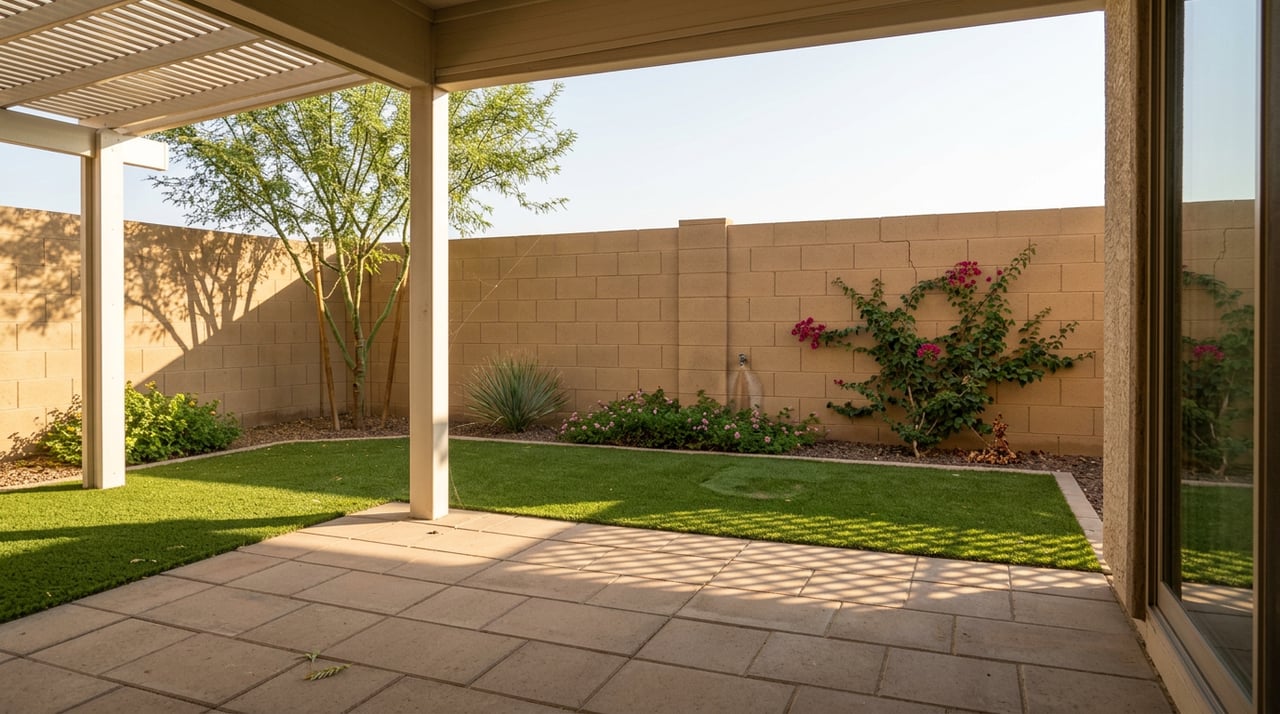
Why would a gated subdivision that stopped building new homes years ago sell for more per square foot than a 650-acre master plan with a resort pool, a golf club next door, and its own urban village? That's the question sitting underneath Gilbert's 85234 zip code right now, and the answer has nothing to do with nostalgia for an older neighborhood.
Eastpoint, the 78-homesite gated community Porchlight Homes built off Power and Guadalupe roads, is fully sold out. No builder incentives, no model homes, no fresh inventory. Every sale there is a resale. And yet closings inside the community in April and May 2024 landed at or above what comparable new construction communities a few miles away were fetching for similar square footage. Those sales offer historical context for Gilbert buyers in 2026, not current comparisons.
The Sales That Don't Fit The Easy Story
Look at what actually closed inside Eastpoint in April and May 2024. A 1,772 square foot home on N Blackbird Drive sold for $520,000 in May 2024. A 2,058 square foot home on E Barbarita Avenue closed the same month for $554,800. A 2,226 square foot home on E Aspen Way sold for $575,000 that April, and another on Blackbird pushed past $600,000. Those reported sales ranged from roughly $260 to $290 per square foot. They offer historical context, not a measure of Eastpoint's current resale band.
Cooley Station North, the newer townhome-and-park-front product a short drive south, had a median sale price near $462,000 in the 2026 market window. Morrison Ranch, the master-planned community built around the historic Four Grains Silos, had a median sale price across all home types of $742,250 as of May 2026, up 1.7% year over year, according to Redfin. Those 2026 figures describe those communities, but they don't establish how Eastpoint's 2024 sales compare with either community today.
Across 85234 as a whole, the median sale price was $543,000 in December 2025 with a median price per square foot of $296, up 5.9% year over year. Eastpoint's April and May 2024 closings offer an older comparison, not a current measure of that market.
What The Sticker Price Doesn't Tell You
Here's the number most comparison shoppers skip past. Gilbert's citywide median list price reached $640,000 in August 2026, at $289 per square foot, according to Movoto's market data, essentially flat year over year after climbing from a $580,000 median sale price back in March. That's the number that shows up in every portal search and every "what's my home worth" email. It's also the number that tells you the least about what you'll actually owe every month.
Buyers comparing Eastpoint to Gilbert's larger master plans are usually comparing two different financial products wearing the same "single-family home" label. A recent East Valley market report made the point plainly: a specialist working these submarkets knows which Morrison Ranch sub-area feeds into the Highland High School catchment or when a Cooley Station builder is about to release its next phase. That first detail, the bond load, is the one that rarely makes it into a listing photo caption.
A CFD bond is a public financing mechanism many large Arizona master-planned communities use to fund the roads, parks, and infrastructure built alongside the homes. The developer fronts the cost. It's often reasonable given what it buys.
It's a small, privately built subdivision with a modest monthly assessment through Trestle Management that covers common-area landscaping, the gate, and the community pool. As an illustration, a buyer comparing a $600,000 Eastpoint resale with a $625,000 Morrison Ranch townhome isn't just comparing two prices.
A Side-By-Side Look
| Community | Price Signal | Community Structure |
|---|---|---|
| Eastpoint | Resales $520K-$600K+ for 1,772-2,226 sq ft (2024 closings) | 78 homesites, gated, sold out, modest HOA covering common areas and pool |
| Cooley Station North | Median sale price near $462,000 (2026) | Townhome-heavy, park-front product within a 650-acre master plan |
| Morrison Ranch | Median sale price (all types) $742,250, +1.7% YoY as of May 2026 | Built around the historic Four Grains Silos, 42-acre community park, trail system |
| Gilbert citywide | Median list $640,000 at $289/sq ft, August 2026 | Mix of resale and active new-construction inventory across all price tiers |
The takeaway isn't that one community beats another. It's that the sticker price alone can't tell you which one is the better financial fit, because the products underneath the price aren't identical.
What's Actually Different Beyond The Bond Question
The amenity gap is real, and it should factor into the decision even without the bond math. Cooley Station's amenity center anchors the community with a pool, basketball and tennis courts, a playground, and a picnic pavilion, with the Verde @ Cooley Station urban village and its Frys Marketplace giving residents daily errands within the development itself. The community sits minutes from Toka Sticks Golf Club, San Tan Village, and the ASU Polytechnic campus across the street.
Morrison Ranch trades on a different kind of value. Its 500-acre footprint carries the name and, in places, the working-farm feel of the Morrison family, who have farmed in Gilbert for more than a century. Tree-lined streets, a 42-acre community park with lighted sports fields, and trail connections give it a different pace than a townhome-dense master plan.
Eastpoint offers neither of those. What it offers is a small, quiet, already-established footprint with a single greenbelt and pool, no ongoing construction noise. For a buyer who values predictability over programming, that trade can be worth more than the square footage suggests.
Questions Worth Asking Before You Compare Two Gilbert Communities
- Does the HOA fee I'm being quoted include a Community Facilities District bond assessment, and if so, what's the remaining balance and payoff date?
- Is the community I'm comparing still an active builder site, or is it fully built out with resale-only inventory like Eastpoint?
- What does the assessment actually fund: a shared pool and landscaping, or a larger network of parks, trails, and retail infrastructure?
- How does the per-square-foot price compare once I account for what's included versus what's billed separately?
None of these questions show up on a listing sheet. All of them change the real monthly number.
FAQ
Is Eastpoint still building new homes? No. Eastpoint is a fully built-out, 78-homesite community. Every transaction there today is a resale.
Why would an older resale community price close to newer construction? Price per square foot reflects more than age. Eastpoint's April and May 2024 sales show that its resales then could reach price-per-square-foot levels comparable to newer product; those transactions don't establish how its current pricing compares. HOA structure also affects the all-in cost, so buyers should compare it separately.
Are CFD bonds bad for buyers? Not inherently. They fund real infrastructure.
If you're weighing an established Gilbert community against a newer master plan and want the real, all-in comparison, not just the number on the sign, The Studebaker Group can walk you through what each community actually costs to own before you write an offer. Schedule a personalized consultation and we'll pull the specifics for the properties you're actually considering.
This article is general information, not legal, tax or financial advice. Consult a qualified professional about your situation.